 Reflections from the Riinvest Institute's Annual Economic Forum (FEV25)
From: Alma Bajramaj
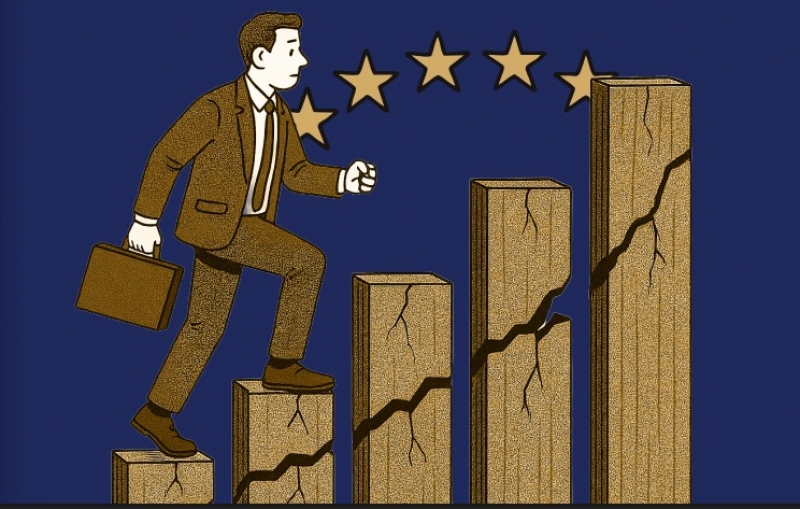
Kosovo’s external sector remains under persistent pressure, reflecting not only domestic structural weaknesses but also rising uncertainty in the global environment. This vulnerability is visible across all of its key components: the trade deficit is widening at an alarming pace; services, despite their growth, remain highly dependent on external and seasonal factors; remittances show signs of slowing; while foreign direct investments continue to be channelled largely into non-productive activities.
The deterioration of the trade balance in recent years is only one symptom of this fragile configuration. The gap between imports and exports has widened once again, revealing an economy that consumes far more than it produces and has yet to build sustainable competitive mechanisms in international markets. This dynamic can no longer be dismissed as a cyclical fluctuation or a temporary side effect of global uncertainty; it is a clear indicator of accumulated structural problems that are constraining growth and limiting the country’s ability to generate added value.
The worst trade deficit of the decade
Between January and September 2025, Kosovo’s exports of goods and services grew by roughly ten percent, reaching the value of €3.8 billion. This expansion, however, was quickly outpaced by imports, which surged to €6.1 billion over the same period. The picture is even more concerning in the trade of goods, where exports recorded a slight decline compared to the previous year, while imports continued to grow at double-digit rates. As a result, the goods deficit has climbed to around €4.2 billion in just the first nine months of the year, with the export-to-import coverage ratio falling to its lowest point in a decade.
One systematic weakness of the external sector lies in the structure of exports, which has remained largely unchanged over time. Base metals and related products still dominate, accounting for roughly one-quarter of total exports — a dependence that leaves the economy highly vulnerable to volatility in global commodity prices. Although these are followed by other minimally processed or low-value-added goods, the overall structure remains heavily tilted toward products that generate limited economic value.
Administrative data further confirm this pattern: most exports are intermediate goods, often dependent on imported inputs. This positioning anchors Kosovo in the middle tiers of global value chains. Put differently, the economy operates neither at the upstream stage of supplying raw materials nor at the downstream stage of producing differentiated final goods, where the bulk of value is created.
There is, however, one encouraging trend. Product diversity has increased: over the last decade, the number of exported items has expanded by 22.5 percent. On average, firms in Kosovo now export around 723 different products per year (4-digit HS level), signalling a broadening of the export base — a positive sign, even if value generation remains limited.
The illusion of increased services
The exports of services are growing, and for now, they help cushion Kosovo’s large trade gap. Yet the composition of this growth raises clear concerns about its sustainability. Much of the recent expansion has been driven by short-term and highly seasonal factors, most notably diaspora spending during the summer months and the increasing volume of passenger flights, both of which are recorded as exported services. These flows depend on diaspora mobility, a factor that lies largely outside domestic policy influence.
Within the service sector, ICT-related services hold the most meaningful long-term potential. Yet despite promising growth, they currently contribute only about nine percent of total service exports. Furthermore, ICT services face rising risks from automation and rapid advancements in artificial intelligence, which are increasingly replacing standard digital tasks. Adapting to these technological shifts is critical for the sector’s future resilience.
Remittances and FDI: yet to catalyze development
Remittances, which have long helped stabilize the external sector, are showing signs of slower growth. By the end of August this year, they recorded a nominal increase of 3.7 percent (from €895 million to €928 million), but international organizations expect real growth to weaken due to slowing economies in host countries where Kosovo’s diaspora resides. This creates a dangerous dependence: for an economy with limited productive output, remittances act as artificial oxygen that sustains consumption and thus imports.
Even more concerning is the pattern observed in foreign direct investment, much of which originates from diaspora capital. Around 80 percent of FDI continues to flow into real estate — a sector that does not support productivity gains and instead diverts capital away from innovative and export-oriented activities. It simultaneously fuels price increases in the housing market and encourages speculative behavior.
Time for policy reset
Amid these dynamics, it is clear that Kosovo cannot continue relying on a growth model driven by consumption, remittances, and non-productive investment. The external sector has entered a phase that requires a thorough policy reassessment: strengthening domestic productive capacities and competitiveness, channeling investments into higher value-added sectors, diversifying the export base, and developing instruments that mobilize diaspora capital beyond real estate are essential steps.
Without a coordinated strategy focused on boosting competitiveness and reinforcing the foundations of domestic production, Kosovo risks remaining highly exposed to external shocks and locked into a development path that delivers neither stability nor long-term prosperity. Now is the moment to treat the external sector not as a number in the balance sheet, but as a strategic priority for the country’s economic future.
supported by:UNFPA, ADA
Download
supported by:EFI/ TEB
Download
supported by:LuxDev, Luxembourg Development Cooperation Agency
Download

supported by:Fondacioni i Kosovës për Shoqëri të Hapur (KFOS)
Download
supported by:Republika e Kosovës
Download
supported by:CARITAS
Download
supported by: U.S. Agency for International Development
Download
supported by: U.S. Agency for International Development
Downloadsupported by:Kosovo Foundation for Open Society
Downloadsupported by:Kosovo Foundation for Open Society
Downloadsupported by: the Kosovo Foundation for Open Society - KFOS
Downloadsupported by: U.S. Agency for International Development
Downloadsupported by: the Kosovo Foundation for Open Society - KFOS, and Open Society Foundation for Albania - OSFA
Downloadsupported by: the Kosovo Foundation for Open Society - KFOS
Download
supported by:Norwegian Embassy & KCSF
Download










supported by:Swiss Cooperation Office in Kosovo
Download